

The short answer
Floor plan lenders will adopt AI in four stages. First, every system a lender runs agrees on who each dealer is. Next, AI answers questions when someone asks. After that it watches the portfolio between questions. Last, agents act on their own inside rules the lender writes.
Governance starts at stage one, and credit decisions stay with people at every stage. Our view is that most lenders will spend 2026 through 2028 working through stages two and three, and that specialty lenders will put agents to work in servicing before banks do.
Where floor plan lenders are with AI right now
Interest has moved faster than deployment. A Moody's study published in January 2026 surveyed 600 risk and compliance professionals and found 53% actively using or trialing AI, up from 30% in its 2023 survey. The barrier they cited most often for scaling it was a shortage of in-house skills, at 41%.
Floor plan programs carry an extra constraint. A wrong answer about a dealer lands on a live credit line, secured by units that are supposed to still be on the lot.
Most AI pitches in this market lead with what an agent could do. We think the order a lender adopts AI in matters more than any demo. We ran a floor plan lending program before we built software for one, and the order below is the one we'd defend in front of a credit committee. (For the tools already earning their keep in floor plan programs, see what we wrote in May.)
The four stages at a glance
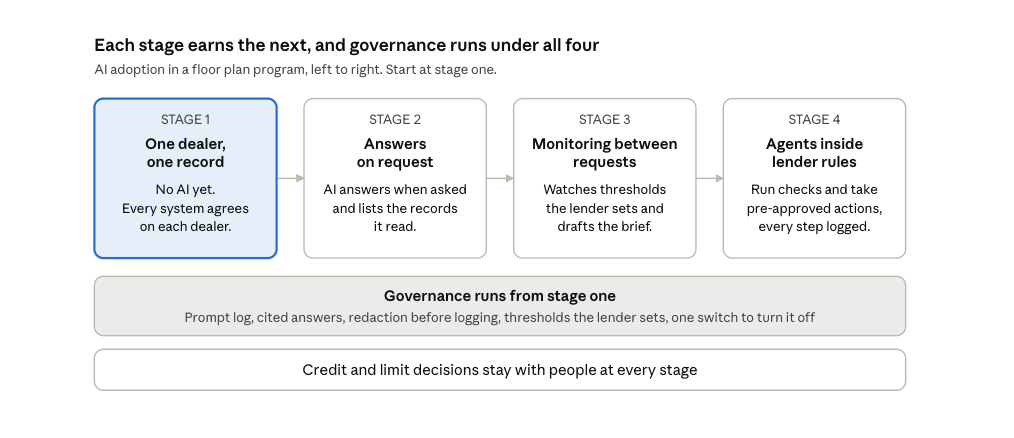
Each stage builds the track record a lender needs for the next one, and the two bands underneath apply from the first stage to the last.
Stage 1: One dealer, one record
Stage one has no AI in it.
It's the point where every system you run describes the same dealer the same way: same legal name, same DBA, same bank accounts, same units. Most floor plan programs hold three or four copies of each dealer. Funding history and curtailments live in the loan system, while audit results usually sit in the audit vendor's portal and title status sits with whoever vaults the paper. Bank statements often arrive as PDFs in a shared folder.
A person absorbs that drift without noticing. An analyst who has covered the same 20 dealers for five years knows two spellings of a name are the same store. A model doesn't know the dealer. It resolves identity from the fields it's given. If a DBA change reached the loan system and never reached the audit vendor, the model either fails loudly or pairs the wrong records and answers with confidence. The confident version is the dangerous one.
The test for stage one is simple. Pull one dealer from each system and compare them. If the records disagree, that's the project. It comes before any AI purchase. Governance starts here too, because governance begins with a map of what a model is allowed to read, and nobody can draw that map for data that hasn't been reconciled.
Stage 2: Answers on request
In stage two AI answers when someone asks, and every answer points back to the records it read. The person who asked still makes the call.
Start with the annual review. It's bounded to one dealer at one date, and it runs on documents. And a credit officer signs it anyway, so a wrong answer gets caught by the person who owns the decision. The hours go into assembling the packet. Dealer financials, payment history, curtailment performance, audit results, inventory aging: each one gets pulled from wherever it lives and stitched into one memo.
In VeroOS, an analyst opens Vero AI from the dealer's page and asks for a dealer brief or a comparison against the portfolio average. (The panel slides in from the right edge of whatever screen you're on. You can drag it out to full width.) The answer comes back as cards and charts built from live records, and it lists the records it read. More than 30 one-click analyses ship with it. A lender's admins can add their own and choose which roles see them. Plain-language questions work too. Ask for dealers above 80% utilization whose payments have been late more than twice this quarter and it builds the view on the spot.
Documents get the same treatment. Vero AI classifies an upload (a financial statement, a title, a bill of sale or an insurance certificate) and pulls out the fields that matter. On a bill of sale that's the VIN, the vendor, the amount, the date. Then it checks each field against the matching record in VeroOS and flags mismatches one field at a time.
Trust gets built in this stage because every answer is checkable. If a brief says a dealer's payoff timing slipped, the analyst clicks through to the payments. Stage two is where a credit team learns how often the system is right, and that track record is what earns the move to stage three. Skip it and nobody has a basis for trusting an alert.
Stage 3: Monitoring between requests
In stage three the system watches without being asked and tells someone when a dealer crosses a line the lender drew. People still decide what happens next.
What changes is coverage. An annual review and a periodic audit leave long stretches where nobody is looking at a given dealer. Continuous monitoring watches the signals that move in between: bank balances through a Plaid connection, NSF events, payoff timing against reported sales, units unverified on consecutive audits, missing titles. We covered those signals, and what they do to audit cost, in Safeguarding Collateral Happens Between Audits.
But the AI's job here is narrower than most people expect. The lender sets the thresholds: utilization caps, payment delays, inventory aging, NSF counts. When Vero AI opens, it leads with what changed, such as dealers over the utilization cap and audits past due. Then it drafts the brief a risk manager would otherwise write by hand. Freezing a line or sending an auditor early stays a human decision.
Roles see the same portfolio differently on purpose. By default the Collections persona looks seven days out and the Analyst persona looks 90, and the lender can change both.
Stage 4: Agents that act inside rules the lender writes
In stage four, AI stops waiting to be asked. An agent, in a floor plan program, is a sequence the system runs on its own when an event fires or a schedule comes due. It checks conditions the lender wrote, takes an action the lender approved in advance and logs every step.
The first agents belong in servicing. Take a funding request: when a dealer submits one, an agent checks the attached documents against the asset record and the required fields. If everything's there, the request goes to the approval queue. If something's missing, it goes back to the dealer with a list of exactly what to send. A collections manager could set another to run every morning, finding dealers whose payment delays crossed the threshold overnight and routing a drafted brief on each to the assigned collector before anyone logs in.
Agents shouldn't approve credit or change a dealer's limit. Those stay with people, and a lender's written AI policy should say so.
Our agent builder is in development and we're not putting a date on it here. It'll live in the Admin Center as a no-code tool. You pick a trigger, such as a new funding request or a change in a dealer's risk score, then add steps from the toolkit Vero AI already uses in conversation. Agents will run under the same audit log and role-based access as the assistant does today.
We expect specialty and non-bank lenders to run agents in servicing before banks do, and the reason is structural. A bank answers to examiners and to its own model risk function, and this year's federal model risk guidance left agentic AI out of scope (more on that below), so a bank's internal policy has to cover agents before anyone switches one on. A non-bank lender answers to its capital providers and moves when its own controls satisfy them. That's our read.
Governance runs from stage one
Governance usually gets planned last, after a pilot works. We'd put it first, and our 2030 planning framework for lenders makes the same call about a compliance framework for AI. An agent in stage four is only as defensible as the audit trail behind it, and that trail has to exist from the first answer in stage two.
The regulatory backdrop shifted this year. On April 17, 2026, the three federal bank regulators issued SR 26-2, revised model risk guidance that supersedes SR 11-7. A footnote in the guidance itself places generative and agentic AI models outside its scope because they're novel and rapidly evolving. The same footnote says a banking organization's own risk management and governance practices should guide how it handles them. Traditional statistical models and non-generative AI models stay in scope. For a floor plan lender evaluating an AI assistant, the governance design is the lender's to write.
Before stage two, ask any AI vendor these questions:
- Can we see every prompt and response by user and screen, then export the log?
- Can we require answers to cite a record, and does the assistant decline when it can't find one?
- Is sensitive data such as SSNs, EINs, VINs or bank account numbers redacted on our side before it's sent, and again before it's logged?
- Who sets the risk thresholds the AI applies, us or the vendor?
- Can our own SOPs override the vendor's default knowledge base? Is there version history with rollback?
- Can one admin turn it off for the whole organization?
- Is there a spending cap, and what happens when we hit it?
Vero AI answers yes to every one of these today. We'd ask every vendor the same list, ourselves included, every time the product changes.
If you want to see stage two run against your own SOPs and thresholds, we'll do it in a 30-minute session. Talk to us.
Frequently asked questions
Can AI make credit decisions in a floor plan program?
It shouldn't, and Vero AI doesn't. AI belongs in the work around the credit decision, like assembling the annual review packet and flagging dealers that cross a threshold. The decision and the signature stay with the credit officer.
What does agentic AI mean in floor plan lending?
An agent is a sequence the system runs on its own when an event fires, such as a new funding request. It checks the conditions the lender wrote and then takes an action the lender approved in advance, logging each step. The sensible first agents sit in servicing (funding request checks, payment-delay briefs) rather than in credit.
Where should a floor plan lender start with AI?
With the dealer record. Once your loan system agrees with your audit and title vendors on each dealer, move to answers on request. The annual review makes a good first workload.
Does SR 26-2 cover generative AI?
No. The agencies issued SR 26-2 on April 17, 2026. It places generative and agentic AI models outside its scope and says a bank's own risk management and governance practices should guide how it treats them. Traditional statistical models and non-generative AI models remain in scope. Your compliance team should read the footnote itself rather than a summary, ours included.
How long does it take a floorplan lender to move through the four stages?
It depends on where the data starts, so stage one sets the pace. Our view is that most lenders will spend 2026 through 2028 in stages two and three.



' d='M11.04 19.32Q12 21.51 12 24q0-2.49.93-4.68.96-2.19 2.58-3.81t3.81-2.55Q21.51 12 24 12q-2.49 0-4.68-.93a12.3 12.3 0 0 1-3.81-2.58 12.3 12.3 0 0 1-2.58-3.81Q12 2.49 12 0q0 2.49-.96 4.68-.93 2.19-2.55 3.81a12.3 12.3 0 0 1-3.81 2.58Q2.49 12 0 12q2.49 0 4.68.96 2.19.93 3.81 2.55t2.55 3.81'/%3E%3C/svg%3E)

