

DataScan sells floor plan audits three ways. Onsite sends its own field auditors to the lot. RiskGauge monitors inventory digitally by pulling in outside data, from retail sales to GPS. uVerifi lets dealers verify units themselves from a phone, and it runs as part of RiskGauge. Since September 2025 all three belong to DataScan by Solifi.
Lenders searching for those names usually want one of two things. Some want to know what each product does. Others are deciding how much physical auditing they still need, now that digital verification is good enough to carry part of the load. This post covers both. We build VeroOS, which runs audits too. So treat the last section as our pitch, and everything before it as the reference.
What each DataScan audit product does
Everything in this section comes from DataScan's and Solifi's own pages, linked inline.
Onsite is the physical audit service. DataScan says it pairs audit technology with "a full-time, in-house team of expert auditors." It used to be called Audit Intelligence; DataScan announced the rename at its April 2025 user conference. Auditors work from an Onsite mobile app that DataScan says lets lenders enforce their own business rules.
RiskGauge is the digital side. Its product page lists the data it can draw on. Dealer management systems and retail sales come first. In-transit systems plus GPS are on the list too, as are physical audit results and uVerifi dealer audits. DataScan calls it "Service Provider Agnostic," meaning it's designed to take results from other audit providers too. The RiskGauge brochure adds duplicate collateral reporting, which flags units floored with more than one lender. The same brochure states a goal to "reduce physical audits by 70% in 5 years."
uVerifi is dealer self-verification. Dealers confirm units with a phone. DataScan says the app checks each submission several ways, including OCR, GPS verification plus image recapture detection. DataScan launched it in 2023 through an exclusive North American agreement with CheckVentory, a software company based in Dublin.
When Solifi announced the acquisition, it said the combined plan "aims to accelerate digital audit innovation with DataScan's RiskGauge solution." Solifi now lists RiskGauge on its own wholesale finance software pages.
Four ways to verify floor plan collateral
Strip away the product names and every audit setup mixes the same four methods. Each one proves something different.
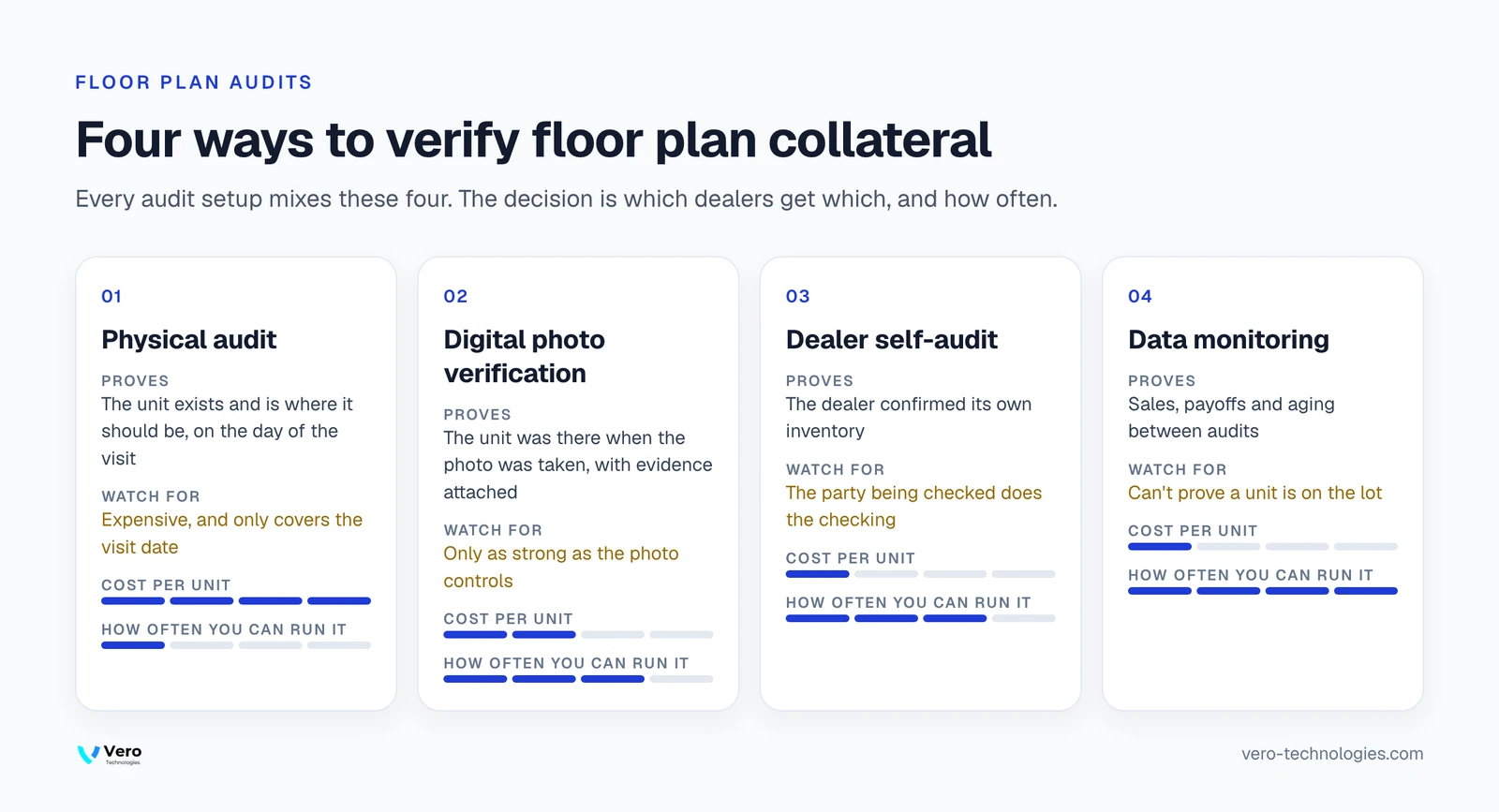
- A physical audit. Someone stands on the lot and checks each unit against the line. It's the strongest proof that a unit exists and is where it should be. It's also the most expensive method, and it only tells you about the day the auditor visited.
- Digital verification with photos. Units are confirmed remotely, with photo evidence attached to each one. It costs less per unit, so you can do it more often. It's only as good as the controls on the photos.
- A dealer self-audit. The dealer verifies its own inventory. Dealers like it because nobody shows up unannounced. It needs strong fraud controls, because the party being checked is doing the checking.
- Continuous data monitoring. Retail sales data, payoffs plus aging get watched between audits. It's the only method that can catch a sold-out-of-trust unit before the next audit date. It can't prove a unit is physically on the lot.
Most lenders will keep some physical auditing for a long time, because a regulator, an investor or the credit committee wants it. The real decision is the mix. Which dealers get a physical visit, and how often? What digital methods carry the rest?

What to ask about any audit setup
These questions work whether you're evaluating DataScan, VeroOS or another provider.
- Where do findings land? An audit result is only useful if servicing sees it. Ask how long it takes a missing unit to reach the person who can freeze the line.
- What happens to an unverified unit? It should escalate on a clock, not sit in a report until month end.
- What fraud controls cover remote and self-audits? Ask how the system detects a recycled photo or a unit photographed somewhere other than the lot.
- Can you change audit providers without changing servicing systems? Some lenders want field audits and servicing from different companies. Find out whether the setup allows that, and who maintains the connection.
- What does it cost per dealer per year? Ask for the price of a physical audit and a digital one. Then ask what drives the number up.
- What does the dealer experience? Audits are a relationship issue. An unannounced visit lands differently than a request to verify twelve units from a phone by Friday.
How an audit finding should travel
The weakest point in most audit programs isn't the audit. It's the gap between a finding and the action it should trigger. Say a unit goes missing on Tuesday, but the funding team learns about it from next month's report. The audit did its job. But the program still lost.
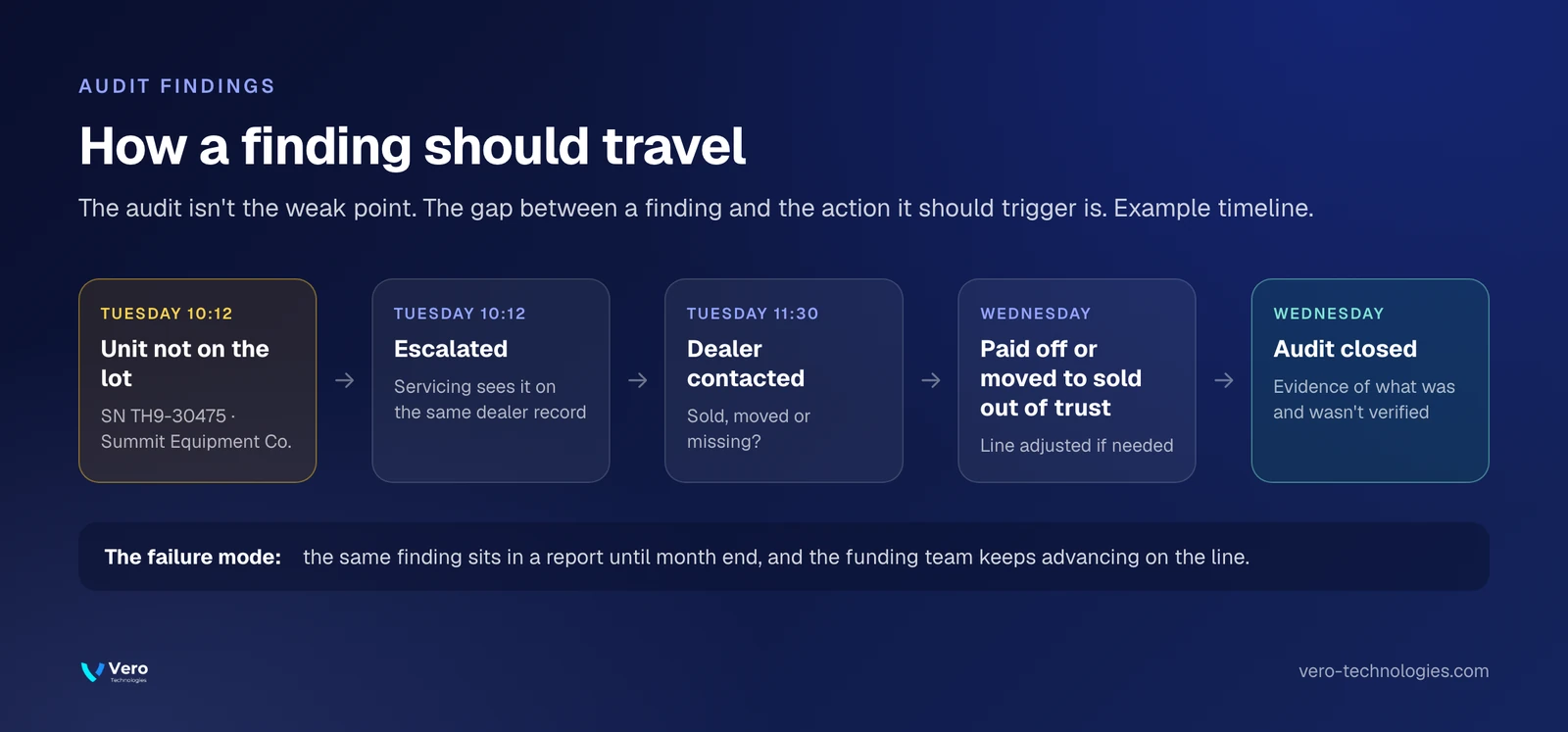
Trace one finding through your current setup. Write down who sees it and when. Note which system it lands in. Then count how many times someone has to rekey it. Each handoff is a delay, and each delay leaves exposure open longer.
Where VeroOS fits
VeroOS runs digital and on-site audits in one workflow. Units that can be confirmed remotely are verified digitally with photo verification. The rest are assigned to an auditor on site. Unverified units escalate instead of sitting, and every closed audit leaves an evidence trail of what was verified and what wasn't.
Audit results land on the same records the credit and servicing teams already work from. Payoff behavior, inventory aging, curtailment performance plus payment exceptions roll into a dealer score that moves week to week, so you can watch the trend between audits.
Audits can deploy on their own next to a core system you keep, or as part of VeroOS running the whole program. Want VeroOS working next to DataScan's audit products for a period? We'd scope any data connection with you and DataScan first. For the full comparison, see VeroOS compared with DataScan. If you're weighing a bigger move, the floor plan conversion checklist covers what moves and how to tie it out.
DataScan audit questions
What is DataScan RiskGauge?
RiskGauge is DataScan's digital inventory risk monitoring product, now part of DataScan by Solifi. DataScan says it draws on outside data such as dealer management systems, GPS plus physical audit results. It also offers duplicate collateral reporting for units floored with more than one lender.
What is DataScan Onsite?
Onsite is DataScan's physical floor plan audit service, formerly called Audit Intelligence. DataScan says it pairs audit technology with a full-time, in-house team of field auditors. They work from the Onsite mobile app, which enforces each lender's own business rules.
What is uVerifi?
uVerifi is a dealer self-verification app that DataScan offers as part of RiskGauge. Dealers confirm units from a phone. DataScan says the app checks each submission with OCR plus GPS verification. It also looks for recaptured images. DataScan launched it in 2023 through an exclusive North American agreement with CheckVentory.
Can digital audits replace physical floor plan audits?
Not completely, for most lenders. Digital verification and data monitoring can cover more units more often, but a physical audit is still the strongest proof a unit is on the lot. The practical choice is the mix. Decide which dealers get a physical visit and how often. Then decide what digital methods cover the rest.
Can VeroOS run audits without replacing our servicing system?
Yes. Audits can deploy on their own next to the core system you keep, or as part of VeroOS running the whole program. If your current core is DataScan's, Vero would scope any data connection with you and DataScan first. Vero doesn't claim an existing integration.




' d='M11.04 19.32Q12 21.51 12 24q0-2.49.93-4.68.96-2.19 2.58-3.81t3.81-2.55Q21.51 12 24 12q-2.49 0-4.68-.93a12.3 12.3 0 0 1-3.81-2.58 12.3 12.3 0 0 1-2.58-3.81Q12 2.49 12 0q0 2.49-.96 4.68-.93 2.19-2.55 3.81a12.3 12.3 0 0 1-3.81 2.58Q2.49 12 0 12q2.49 0 4.68.96 2.19.93 3.81 2.55t2.55 3.81'/%3E%3C/svg%3E)

